

How does Ectoin® natural function as a skin barrier repair active in sensitive skin?
A single 0.5% Ectoin® natural application has been shown to reduce TEWL by up to ~47% within 48 h on tape-stripped (compromised) skin, consistent with faster barrier normalisation versus untreated control 1. Functionally, Ectoin® is used in sensitive-skin formulations to keep barrier-side water binding stable under stress via a compatible-solute mechanism that structures and binds water molecules at protein and membrane surfaces.
bitop AG (Witten, Germany) — Ectoin® natural (cosmetic grade). Positioned as a barrier-repair active for sensitive-skin formulations, Ectoin® is a compatible solute with a defined cosmetic use-level corridor of 0.3–2.0% w/w suited to leave-on systems. In an in-vivo barrier-disruption model (tape stripping), a single 0.5% Ectoin® natural application produced acute and sustained reductions in transepidermal water loss (TEWL) for up to 48 h, supporting faster normalisation of barrier function 1. Scope: cosmetic claims should stay in barrier support/comfort/TEWL reduction on compromised skin and avoid disease-treatment language.
Why this matters now
Sensitive-skin briefs increasingly anchor on barrier recovery because irritation exposure is routine (cleansing, friction, climate, procedures, cycling strong actives) while tolerance for prolonged barrier impairment is low. Development targets typically translate to: demonstrate recovery after a defined insult through TEWL normalisation, then support the consumer story with comfort-linked endpoints (e.g., visible redness, perceived reactivity) in a low-irritancy system.
Commercially, barrier repair skincare is reported at USD 2.41B in 2025 and projected to USD 4.62B by 2034 (7.4% CAGR), which raises internal comparator expectations: ceramides, niacinamide, panthenol, and hyaluronic acid are common reference actives in barrier-first discussions. For sensitive-skin positioning, “success” is usually evidenced by TEWL reduction on compromised skin plus improved appearance/feel (less visible redness, better comfort) without relying on common sting triggers (aggressive solvents, high fragrance loads).
Evidence (clinical + in-vivo)
Ectoin®’s barrier-repair positioning is primarily supported by compromised-skin studies where the insult is created to elevate TEWL versus baseline (e.g., tape stripping, SLS/SDS challenge), then recovery is tracked via TEWL and comfort-linked endpoints such as erythema 1. Externally, the clean framing is cosmetic: improved barrier function on compromised or sensitive/atopic-prone skin, avoiding atopic dermatitis treatment language 2.
Model-aligned takeaways:
Acute barrier disruption (tape stripping): A single 0.5% application reduced TEWL rapidly and durably over 48 h on tape-stripped skin 1. Separate short-term clinical in-vivo data report TEWL reduction up to 60–72% within 48 h after barrier disruption 1. These designs fit “fast post-insult recovery” briefs where claims can be substantiated as TEWL reduction / barrier repair on compromised skin 1.
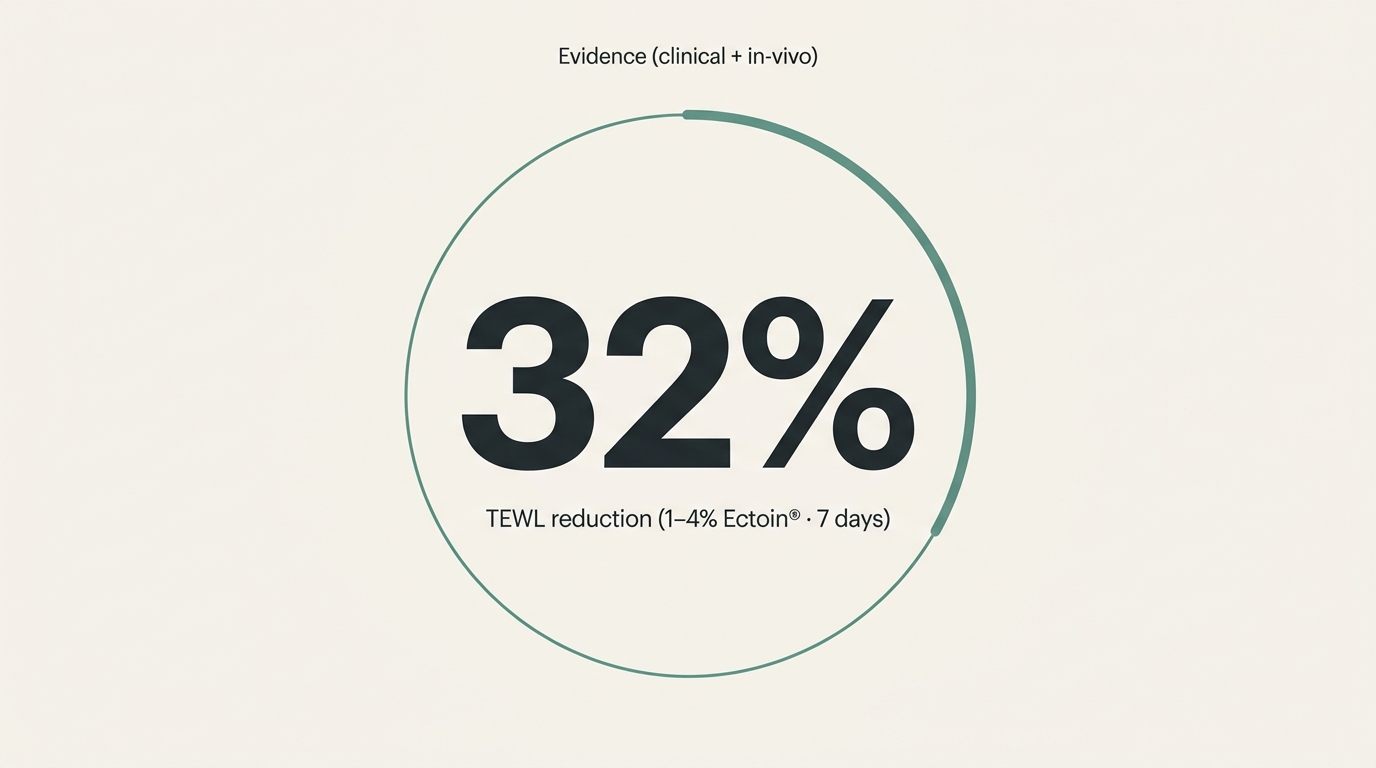
Surfactant/irritant stress (SLS/SDS): After SLS exposure, 1–4% Ectoin® reduced TEWL by up to 32% within 7 days versus control/placebo 3. Following SDS-induced barrier damage, 4% formulations showed the strongest TEWL reduction over 9 days 3. This maps to routines with repeated wash-stress where chemical irritation, not just mechanical disruption, drives barrier impairment.
Sensitive/atopic-prone clinical contexts (claim-bounded): In atopic dermatitis patient datasets, Ectoin® cream (EHK02) significantly reduced SCORAD and TEWL, indicating improved barrier status 2, and an Ectoin®-containing cream improved barrier function, hydration, and AD symptoms including dryness and erythema 2. Use these data to guide formulation and internal justification; externally, constrain wording to “atopic-prone/sensitive skin” and cosmetic endpoints (barrier support, helps reduce dryness, helps reduce visible redness) 2.
Study model | Ectoin® use level (% w/w) | Endpoint(s) | Effect size / time window | Regulatory note |
|---|---|---|---|---|
Tape stripping (acute disruption) | 0.5% | TEWL | Reduced TEWL by up to ~47% within 48 h | Claim as TEWL reduction / barrier repair on compromised skin 1 |
Barrier disruption (short-term clinical in vivo) | not specified in note | TEWL | TEWL reduction up to 60–72% within 48 h | Keep cosmetic “barrier support/repair” wording 1 |
SLS challenge | 1–4% | TEWL | Reduced TEWL by up to 32% within 7 days vs control/placebo | Suitable for “helps protect against wash-stress” framing 3 |
SDS-induced barrier damage | 4% | TEWL | Strongest TEWL reduction over 9 days | Keep to barrier function support on irritated/compromised skin 3 |
Atopic dermatitis patient context | not specified in note | SCORAD; TEWL | Significant reduction in SCORAD and TEWL | Use “atopic-prone” externally; avoid AD treatment claims 2 |
When referencing atopic dermatitis datasets, restrict external-facing claims to “atopic-prone” or “sensitive skin” barrier support and avoid disease-treatment wording.
How Ectoin® works
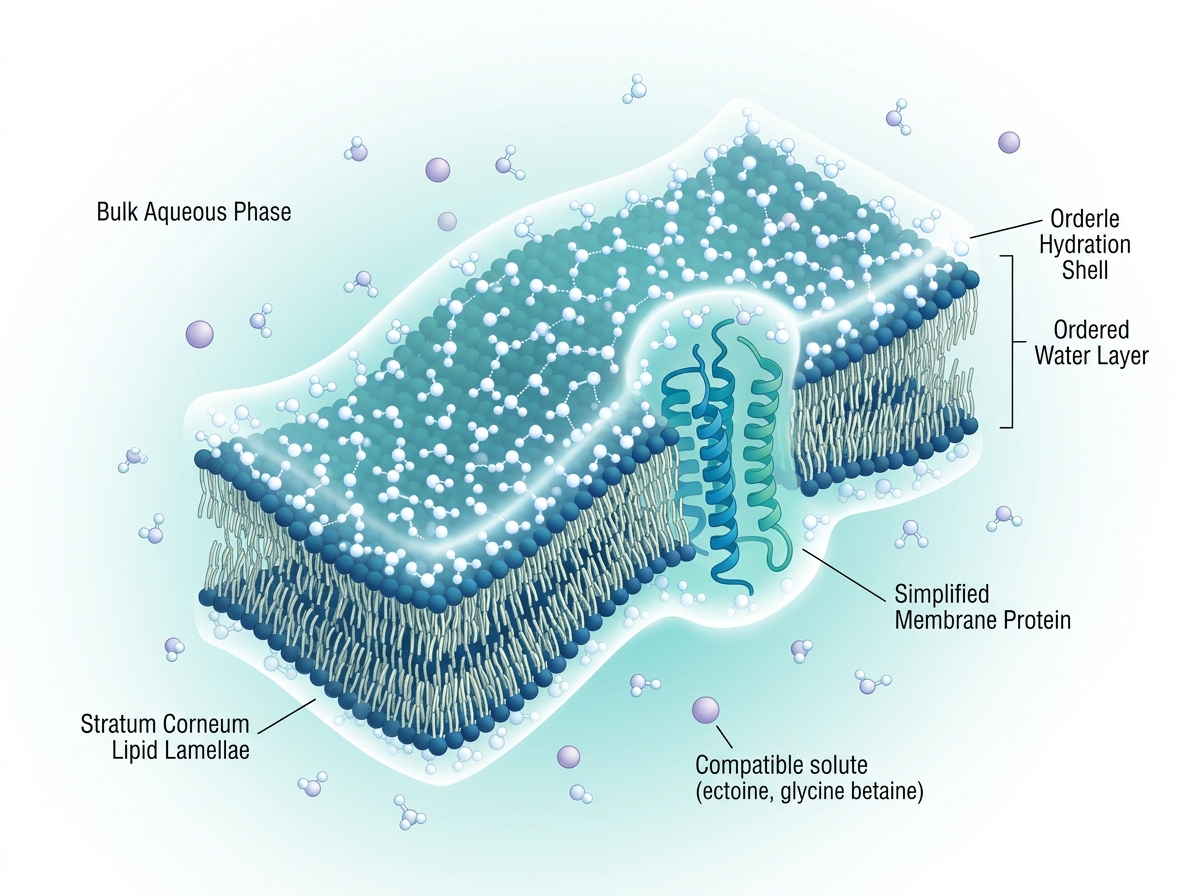
Ectoin® supports barrier repair by preferential exclusion from protein and membrane surfaces, stabilising the hydration shell and reducing conformational stress under dehydration, osmotic load, heat, and UV-driven oxidative challenge. In skin-relevant models, this aligns with barrier integrity signals such as increased claudin‑1 in keratinocytes and downstream TEWL normalisation on compromised skin 2. The practical value is a barrier-support route that is not limited to occlusive film-forming.
As an extremolyte (microbial stress-protection molecule), Ectoin®’s cosmetic relevance follows from how it structures and binds water molecules at biomolecular interfaces under stress 5. Mechanism-to-readout links used in development:
Preferential exclusion / hydration-shell stabilisation → supports protein and membrane surface stability under dehydration stress → improved barrier function and TEWL recovery on compromised skin 2.
Barrier-structure signalling (tight junction support) → increased claudin‑1 in keratinocytes in vitro → supports barrier-integrity rationale for sensitive-skin concepts 2.
Environmental stress resilience (secondary UV defense / pollution) → reduced lipid oxidation under pollution stress (MDA) and cyto-protective effects in UV-irradiated skin models → supports “helps protect against environmental stress” positioning via oxidative-damage markers and resilience under exposome load 4.
When discussing UV-related effects, describe Ectoin® as secondary barrier defence and do not position it as a UV filter or substitute for sunscreens.
Practical application in formulation
Ectoin® is typically deployed as a water-compatible active in leave-on products to support TEWL reduction on compromised skin and improve tolerability in sensitive-skin concepts. Formulation choices generally reduce to: stay within 0.3–2.0% w/w, include in the water phase, and build the rest of the system (lipid replenishment + appropriate occlusion) without adding sting/tack 1.
Use-level selection should follow the recovery objective and substantiation plan. For rapid post-insult normalisation, start mid-corridor, then iterate against TEWL and redness/comfort readouts rather than sensory alone; acute-recovery claims require measurable short-window performance.
Placement is typically aqueous phase (serum, gel-cream, cream). Ectoin® then supports barrier-side water binding/comfort while the base handles lipid architecture and reduction of evaporative loss. Pairing is additive: Ectoin® can sit alongside ceramide/cholesterol/fatty-acid frameworks and with niacinamide, panthenol, or hyaluronic acid, provided the overall system avoids common reactivity triggers (solvent aggression, high fragrance).
A lab-facing evaluation checklist aligned with cosmetic claims:
Use level: 0.3–2.0% w/w (start point set by desired barrier/comfort ambition) 1
Format: leave-on serum / gel-cream / cream (aqueous phase inclusion)
Co-actives: ceramides + cholesterol + fatty acids; niacinamide; panthenol; hyaluronic acid (design patterns)
Readouts: TEWL plan on compromised-skin protocol; erythema scoring/visual redness; basic tolerability screen (sting/burn, repeat-application comfort)
Starting-point formulation
A balanced O/W sensitive-skin barrier-repair cream base combining skin-mimicking lipids, humectants, and Ectoin® for a mild, fragrance-free frame.
Phase | Ingredient (INCI) | % w/w | Function |
|---|---|---|---|
A | Aqua (Water) | 54.50 | solvent |
A | Glycerin | 5.00 | humectant |
A | Butylene Glycol | 3.00 | humectant |
A | Ectoin® | 0.80 | osmolyte |
A | Panthenol | 1.00 | humectant |
A | Avena Sativa (Oat) Kernel Flour | 1.00 | soothing |
A | Allantoin | 0.30 | soothing |
A | Xanthan Gum | 0.20 | rheology modifier |
A | Sodium Hyaluronate | 0.10 | humectant |
A | Disodium EDTA | 0.10 | chelator |
A | Sodium Citrate | 0.15 | buffer |
B | Cetearyl Alcohol | 3.00 | consistency agent |
B | Glyceryl Stearate | 2.50 | co-emulsifier |
B | Cetearyl Olivate (and) Sorbitan Olivate | 3.50 | emulsifier |
B | Caprylic/Capric Triglyceride | 4.00 | emollient |
B | Squalane | 4.00 | emollient |
B | Butyrospermum Parkii (Shea) Butter | 3.00 | occlusive |
B | Simmondsia Chinensis (Jojoba) Seed Oil | 2.00 | emollient |
B | Helianthus Annuus (Sunflower) Seed Oil | 1.50 | barrier lipid |
B | Ceramide NP (and) Ceramide AP (and) Ceramide EOP | 0.30 | barrier lipid |
B | Cholesterol | 0.20 | barrier lipid |
C | Niacinamide | 2.00 | skin conditioning |
C | Bisabolol | 0.20 | soothing |
C | Tocopherol | 0.50 | antioxidant |
C | Phenoxyethanol (and) Ethylhexylglycerin | 1.00 | preservative |
C | Citric Acid | 0.15 | pH adjuster |
Heat Phase A and Phase B separately to ~75–80 °C, emulsify B into A under shear, cool and add Phase C at ≤40 °C, then adjust to pH ~5.0–5.5.
Work with Ectoin® natural
Take the next step with bitop AG (Witten, Germany):
Request a sample of Ectoin® natural for your lab trials.
Get the Scientific Brochure 2026 — the full efficacy and claim dossier.
Formulation support from our technical team for your brief.
Contact bitop AG to request a sample or the brochure.
Cosmetic scope and governance
This article covers cosmetic-grade Ectoin® natural for appearance- and barrier-support claims only; it makes no medical, drug, or therapeutic claim. Genuine medical indications — for example the therapy of dermatitis or ocular disease — fall under the separate medEctoin® medical-device scope and are not a cosmetic claim. Where a study uses a pharmaceutical comparator, that context is scientific background, not a statement of drug-equivalent efficacy for a cosmetic product.
References
bitop AG. Inovapothek Study Scientific Summary of Clinical Study Findings.
bitop AG. TD Clinical evaluation report Dermaveel. Doc-0003014 Rev. 4.0. 2023.
bitop AG. TD Clinical Evaluation report EHK02, EHK25. Doc-0003108 Rev. 8.0. 2024.
bitop AG. Clinical Evaluation_EHK16. Doc-0002944 Rev. 3.0. 2020.
bitop AG. Multifunctional role of ectoine as a natural cell protectant_Graf et al 2008.





Disha Patel
Senior Technical Sales Manager
Auf dem bitop-Blog schreibt sie über neue Anwendungsfelder von Ectoin® und Glycoin® in Skincare-Formulierungen, kombiniert Klinikdaten mit Formulator-Perspektive und übersetzt aktuelle Trends aus der Kosmetikbranche in konkrete Formulierungs-Empfehlungen. Sie leitet außerdem technische Workshops und Trainings für Formulator-Teams weltweit.
Themenachsen: Claim, Application, Trend.


